Higher education has been under real pressure lately. Enrollments are growing, budgets are not keeping up, hybrid learning is here to stay, and everyone expects digital systems that just work without friction. The problem is, a lot of institutions are still running on platforms that were never really built for this version of education.
At the centre of everything is the Learning Management System. It is where courses live, assignments get submitted, progress gets tracked, and most of the day-to-day student experience actually happens. Most people in academic leadership already know it matters. What does not get discussed enough is how wide the gap has become between what older systems can realistically do and what institutions now need from them.
Legacy LMS platforms tend to buckle when usage spikes, do not connect smoothly with the tools faculty actually use, and rarely offer much beyond basic reporting. Modern systems are built differently. They handle scale without breaking down, integrate with other platforms more cleanly, and give institutions real visibility into how learning is actually happening, not just whether content was uploaded.
This blog breaks down why upgrading to a Moodle LMS solution has stopped being something institutions can delay and started being something they genuinely cannot afford to put off.
The Growing Demand for Online Learning in Institutions
Students want flexibility. Faculty are managing in-person and online teaching simultaneously. And institutions are being pushed to reach more students without continuously driving up costs. For many institutions, online learning has simply become part of how education works.
This shift has been building for years before anything forced it into overdrive. Online learning stopped being treated as a contingency and became something students now actively expect when choosing a program. A well-run online program can bring in students from well beyond a campus’s geographic reach without requiring physical expansion. But with that opportunity comes pressure.
Delivering online learning consistently and at scale needs systems that can genuinely handle it, and a lot of older platforms were never built with that in mind.
Limitations of Traditional or Outdated LMS Platforms
Most institutions did not land on their current LMS after a thorough evaluation. It was already there, it was affordable, or switching felt like a bigger project than anyone had the bandwidth for. For a time, it held up. But online learning has grown significantly, and many of these platforms have not evolved with it.
The limitations tend to show up in the same areas:
- Mobile experience is lacking: Students are largely on their phones, but most legacy platforms were designed for desktops and never properly adapted.
- Integrations are unreliable: Connecting older systems with the tools faculty actually depend on is rarely straightforward and often breaks down.
- Analytics barely scratch the surface: They can confirm a student logged in, but offer little visibility into whether learning is actually taking place.
- Scalability becomes a problem: As enrollment grows or traffic spikes around assessments, older platforms start to struggle at exactly the wrong moments.
- The interface works against adoption: When a system is frustrating to use, faculty work around it, and students disengage from it.
Upgrades and patches can extend the life of these digital learning management systems for a while. But they do not address what is fundamentally a structural mismatch between old platforms and modern learning needs.
Key Features of a Modern LMS Institutions Need
A Moodle LMS solution is not just a cleaner interface on top of the same old structure.
It’s a fundamentally different approach to how learning gets delivered, managed, and measured. The institutions that have made the switch are not just working with better technology. They are working with systems that are actually designed around the way online education functions today.
The features that make a real difference tend to be the ones that remove friction rather than add capability:
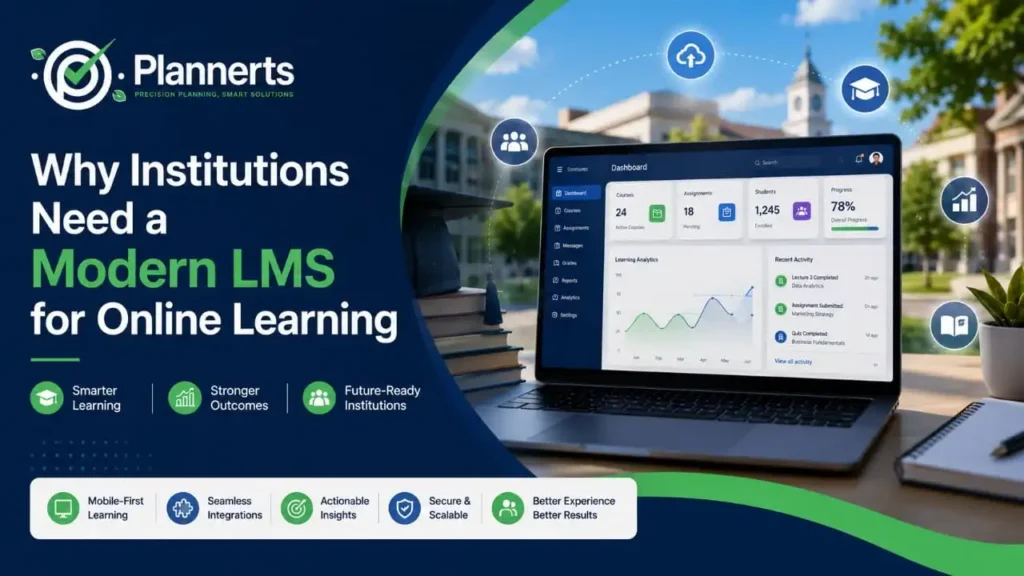
- Mobile-first experience: Most students are on their phones, not laptops. They are checking deadlines between classes, submitting work late at night, and watching lectures on the go. The LMS needs to work properly for that, not just technically on a smaller screen.
- Clean integrations: Faculty are already using Zoom, Google Workspace, Teams, and a handful of other online education tools for Institutions. They should not have to fight their LMS to make those connections work. A modern digital learning management system fits into existing workflows without creating new ones.
- Actionable analytics: There is a difference between data and useful data. Institutions need to know which students are disengaging, which courses are losing people, and where problems are forming, early enough to actually do something about it.
- Reliable scalability: Exam seasons hit hard. Enrollment grows year on year. A platform that struggles under that kind of pressure is not just a technical inconvenience; it affects the entire learning experience at the moments that matter most.
- Intuitive design: If faculty need IT every time they want to do something routine, that is time gone. If students cannot find what they need without emailing someone, that is trust gone. Good design removes both problems before they start.
- Hybrid learning support: Most institutions are running in-person and online programs alongside each other now. A Moodle LMS solution has to serve both equally well because students on either side notice when one experience has clearly been treated as the priority.
The difference is not just in what these systems can do. It is in what they stop making people work around.
How a Modern LMS Improves Learning Outcomes
When a student drops out of an online course, the reason is rarely the quality or authenticity of the content. It’s often something smaller than that.
The reason is that
- They couldn’t find the assignment
- The platform logged them out mid-submission
- The platform isn’t performing as expected
- It takes too long to log in
- The interface is too confusing
These reasons are not dramatic failures. They are the kind of friction that builds up quietly until someone just stops showing up.
Students who can access their coursework without running into walls are more likely to stay engaged. Faculty who get early signals about which students are falling behind can actually do something about it before it’s too late.
The focus shifts back to learning rather than troubleshooting when
- Feedback moves faster
- Grades sync properly
- Everything works the way it is supposed to
This shift in experience is what makes it better outcomes are actually built on.
How to Choose the Right Moodle LMS Solution for Your Institution
The platform you land on shapes how faculty teach, how students experience online learning, and how much visibility leadership has into what is actually working.
Getting it wrong is costly, not just in licensing fees but also in the time and disruption that comes with undoing a poor implementation. If your institution is at the point of making this decision and you want a partner who understands both sides of it, Plannerts works with schools, colleges, and training providers to implement and customize Moodle LMS solutions that fit how you actually operate. Learn more at Plannerts.
Conclusion
Online learning is not a side project for institutions anymore. It’s central to how education gets delivered, how students choose programs, and how institutions stay competitive.
The LMS is at the middle of all that either supports that reality or quietly works against it. A Moodle LMS solution changes what is possible day-to-day. Faculty spend less time working around the system and more time teaching. Students get an experience that actually works. Administrators get data they can act on rather than reports they file away.
Schedule a consultation with Plannerts today and take the first step toward a learning environment your faculty and students can genuinely rely on.
Frequently Asked Questions (FAQs)
1. How much does a modern LMS typically cost?
It varies. Open source platforms like Moodle have no licensing fees but require implementation and hosting costs. Proprietary platforms charge per user or annually. Total cost depends on institution size, customization needs, and support requirements.
2. Can a modern LMS support compliance and accreditation requirements?
Yes. Most modern platforms support SCORM, xAPI, and accessibility standards like WCAG, which are baseline requirements for accredited institutions.
3. Is a cloud-based LMS better than a self-hosted?
Cloud-based is easier to maintain and scales automatically. Self-hosted gives more control but requires dedicated IT resources. Most institutions are moving toward cloud-based solutions for reliability and reduced overhead.
4. How do students benefit directly from a modern LMS?
Faster feedback, easier access to course material, and a platform that works reliably on any device. The experience feels less like a bureaucratic system and more like something built for learning.
5. What should institutions do before switching to a new LMS?
Audit current usage, involve faculty early, assess existing content formats, and set clear goals for what the new platform needs to deliver before evaluating vendors.