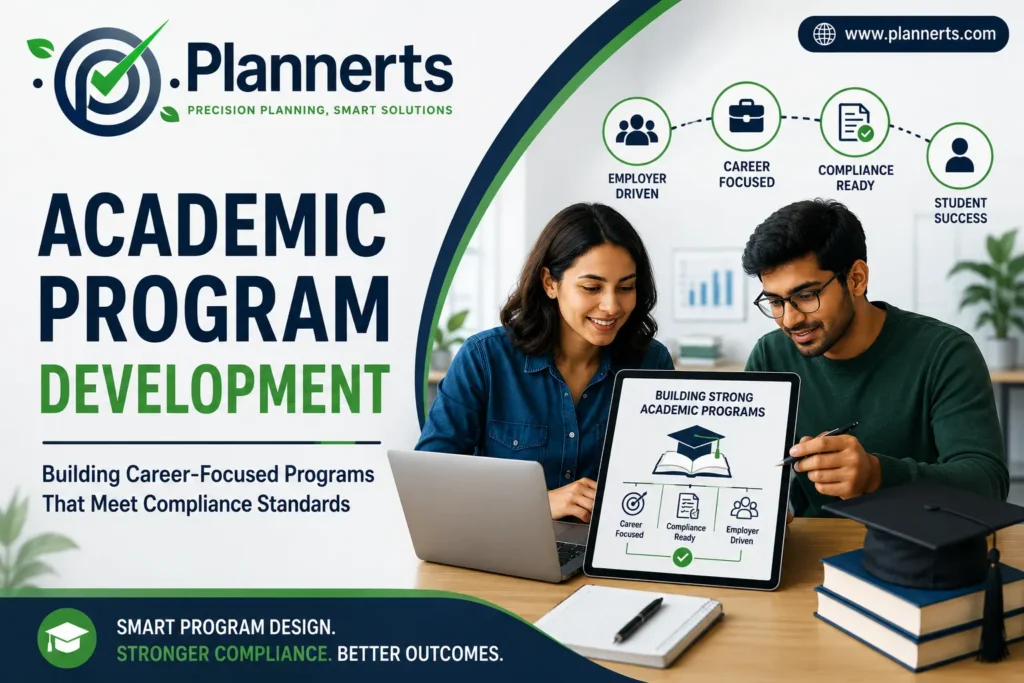
Building a career-focused academic program is not just a curriculum exercise. It’s one of the most operationally complex things a career college or training institution can take on, and most get it wrong the first time. Not because they lack good ideas. They start with content before they sort out structure, compliance, and outcomes.
The result is a program that looks complete on paper but falls apart during regulatory review, fails to attract the right students, or produces graduates that employers are not asking for. Academic program development done properly fixes all three problems at once. It aligns your curriculum with real job market demand, structures your documentation for provincial approvals, and builds a program that your institution can actually deliver consistently.
This guide breaks down exactly how to do that. Whether you are building a new program from scratch or fixing one that is underperforming, the process is the same, and it starts before you write a single lesson plan.
What Academic Program Development Actually Means
Academic program development is the full process behind building something that lasts. It starts with understanding the current and emerging labour market needs. From there, it moves into defining what the program is actually trying to achieve, structuring courses so skills build on each other in a logical order, writing learning outcomes that can be properly assessed, and producing documentation that meets Canadian provincial standards when it lands on a regulator’s desk.
It also covers how the program runs day to day. How it sits inside your LMS, how different instructors deliver it consistently, and how your institution tracks and reports student progress in a way that holds up under scrutiny. When you get all of that right from stage one, you give your program the strongest possible foundation for approval and everything that comes after it.
Compliance Standards Canadian Career Colleges Must Know
Compliance does not begin when a program is submitted for approval. It begins the moment program design starts.
Many institutions only realize this after their first submission is returned with revision requests. One of the most common reasons programs require revision is not missing documentation, but weak learning outcomes. Outcomes that are vague, broad, or disconnected from what the course actually teaches will not hold up under regulatory review.
Beyond learning outcomes, regulators assess whether the program functions as a coherent whole:
- Does the course content directly support the stated outcomes?
- Is the program duration justified by instructional delivery and workload?
- Are admission requirements clearly defined and appropriate for the credential level?
- Does the structure create a logical progression toward employment readiness?
For institutions pursuing OSAP eligibility, there’s an additional layer. While eligibility is primarily based on formal designation and program approval status, institutional performance indicators may still influence audits and ongoing regulatory confidence.
Five Elements Every Strong Academic Program Needs
Most programs that fail regulatory review are not missing content. They are missing structure.
These five elements are the foundation of course design strategies that separate programs that get approved and deliver results from those that look complete but fall apart under scrutiny.
Clear and Assessable Learning Outcomes
Learning outcomes aren’t a formality. They are the spine of your entire program. The problem most institutions run into is writing outcomes that sound good but cannot be measured. Strong outcomes are written in observable, measurable language. If you cannot design an assessment around an outcome, rewrite it before anything else moves forward.
Logical Course Sequencing
The order your courses run in is a design decision, not a scheduling one. Good sequencing builds deliberately. Each course assumes what the one before it covered and prepares the student for what comes next. When you map this out properly, you are not just listing courses. You are demonstrating a logical progression toward a defined employment outcome.
Industry-Aligned Curriculum
A program that does not reflect current labour market needs is a problem you will not catch until your graduates start struggling. By then, your enrollment numbers will already be telling the story. Strong curriculum development for colleges means reviewing current job postings, talking to employers, and cross-referencing occupational standards.
A Solid Assessment Framework
Your assessments are how you prove the program works. Weak assessments that are vague or disconnected from learning outcomes do not give you real evidence of student competency. They just create the appearance of progress. One question to keep asking: Can you point to specific assessments that prove a graduate is ready for the job? If the answer is unclear, the framework needs more work.
Assessment, Evaluation, and Quality Assurance
A program does not stay strong on its own. Without a formal evaluation system, even a well-built program drifts out of alignment, and most institutions do not notice until a regulatory review forces the conversation.
This means actively tracking completion rates, graduate employment outcomes, and instructor delivery consistency. Then, using that data to make documented improvements. Provincial regulators expect institutions to demonstrate that this cycle is actually happening. Documentation of your evaluation process is part of what keeps your institution in good standing during audits and renewals.
How to Build A Curriculum That Produces Work-Ready Graduates
Building a curriculum that leads to real employment outcomes does not happen by accident. It requires deliberate decisions at every stage of program design. Here is how to get it right.
Start with the job, not the subject
Before building anything, look at what the job actually requires. Pull current postings in your target field. Cross-reference with the National Occupational Classification system. What the market is consistently hiring for is what your program needs to deliver.
Map every course to a real workplace skill
Every course in your program should connect directly to a competency graduates will use on the job. If it cannot justify that connection, it does not belong in the program.
Gather industry input before you launch
Structured conversations with five to ten industry professionals before launch will surface gaps that no internal review ever catches. Their feedback is free. Rebuilding a misaligned program after approval is not.
Build a review cycle into your calendar
Curriculum development for colleges and institutions does not stop at launch. Labour market demand shifts faster than most institutions update their programs. Build a formal review process into your program calendar from day one.
Why LMS Integration Must Happen During Program Design
Most institutions build their program first and drop it into an LMS later. That approach creates more problems than it solves. Course structures that do not translate cleanly into digital delivery, assessment configurations that have to be rebuilt from scratch, and reporting setups that cannot actually track what regulators want to see.
LMS integration is not a technical step at the end. It is a design decision that belongs at the beginning.
Structure your program with digital delivery in mind
How your courses are sequenced, how assessments are configured, and how student progress is tracked all need to work inside your LMS from day one, not be retrofitted after approval.
Your LMS should reflect your compliance requirements
Attendance tracking, grade reporting, and completion records are not just operational needs. They are the documentation your institution may need to produce during an audit. If your LMS is not configured to capture that data properly, you are creating a gap.
Consistency across instructors depends on it
When your program lives properly inside an LMS, every instructor delivers it the same way. Without that structure, program quality becomes dependent on the individual, not the institution.
At Plannerts, our Moodle LMS implementation is built specifically around how career colleges operate. We configure your environment to match your program structure, compliance requirements, and reporting needs from the ground up. Learn more about our Moodle LMS service.
Conclusion
Building a career-focused program is not something you figure out as you go. By the time the gaps show up, during regulatory review, in your enrollment numbers, or in your graduate outcomes, fixing them is already costly.
The institutions that get this right treat program development as a structured process from day one. Not a curriculum exercise. A complete operational decision.
If your institution is building a new program or fixing one that is underperforming, that is exactly what Plannerts is built for. From academic program development and curriculum development for schools, colleges, and institutions to Moodle LMS implementation, we help career colleges build programs that get approved and produce graduates employers actually want to hire.
Book a consultation with Plannerts today.
Frequently Asked Questions (FAQs)
1. How long does academic program development take?
It depends on program complexity and the provincial approval process. Institutions with clear outcomes and compliance-aligned documentation move through approval significantly faster.
2. What is the most common reason program submissions get sent back?
Weak learning outcomes. Vague or unmeasurable outcomes that don’t connect to course content are the single most common reason.
3. Do we need industry input before submitting a program?
Not always a formal requirement, but it significantly strengthens your submission and grounds your curriculum in real market demand.
4. Can we add LMS integration after approval?
You can, but structures not designed with your LMS in mind often need rebuilding. Integrating during design saves time and ensures compliance reporting works from day one.
5. What is the difference between assessment and quality assurance?
Assessment measures whether students are meeting learning outcomes. Quality assurance measures whether the program itself is working over time.