
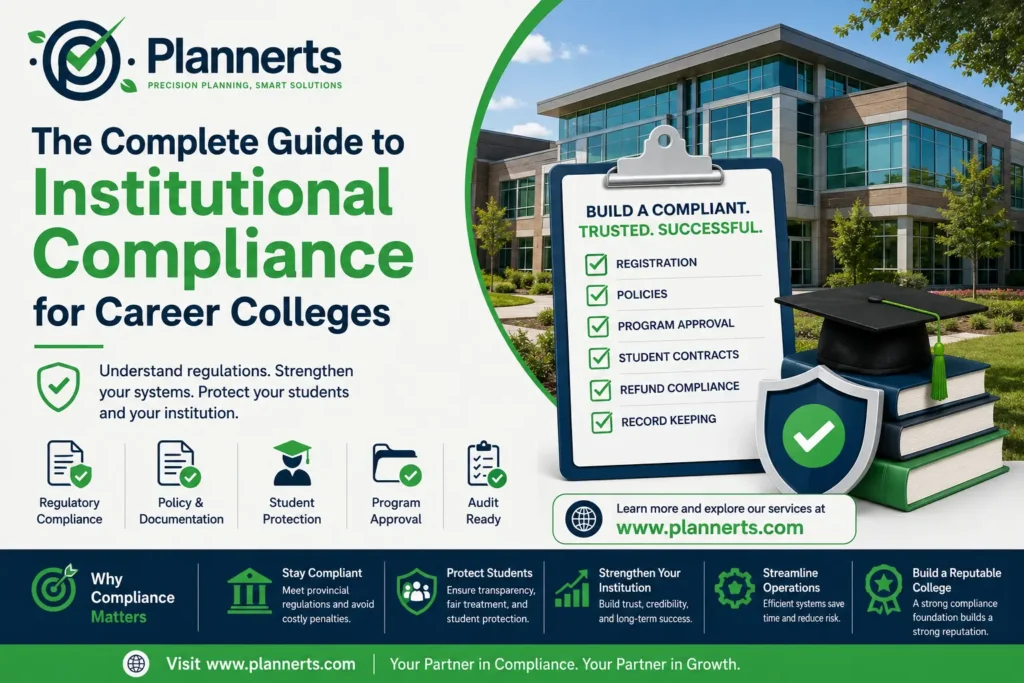
Running a career college in Canada is not just an educational endeavour. It’s a regulated operation, and the regulations do not sit still.
Provincial governments have tightened their oversight of private career colleges over the last decade. Program approval processes have grown more demanding. Student protection requirements have expanded. And the penalty for getting it wrong, whether through an outdated policy, a missed renewal, or a documentation gap, falls squarely on the institution.
Most administrators did not get into education to become compliance experts. They got into it to build career college programs, support students, and grow something meaningful. But at some point, usually around the time an audit notice arrives or a registration renewal gets complicated, the weight of the regulatory side becomes impossible to ignore.
This guide covers what institutional compliance actually means for career colleges in Canada, where the real pressure points are, and what a structured approach looks like in practice.
What does “Institutional Compliance” Mean?
Institutional compliance, for a career college service, means operating within every layer of obligation your institution carries at any given moment, including provincial registration, career college program approval status, student contract requirements, refund policies, advertising standards, and instructor qualifications, among others.
Regulations get updated. Approval conditions change. A policy that was compliant when it was written may no longer be by the time it is actually tested. Furthermore, compliance is not a status you achieve once. It is something your career development institution either maintains actively or loses gradually, often without noticing until the cost of catching up becomes significant.
Why Institutional Compliance Matters
Non-compliance is not just a paperwork problem. The consequences are operational, financial, and reputational, and sometimes all at once.
- A registration lapse can suspend your ability to enroll new students entirely.
- A non-compliant student contract can trigger refund obligations the institution was not financially prepared for.
- A career college program that loses approval mid-delivery leaves students in a vulnerable position and the institution exposed.
- Poor record-keeping can turn a routine audit into a prolonged regulatory dispute.
- Outdated policies, even ones that were never intentionally ignored, can be treated as violations under provincial standards.
There’s also a quieter cost that does not show up in penalty notices. Career development institutions without a clear compliance structure spend most of their administrative capacity reacting rather than building. That has a price, and it comes out of everything else the college is trying to do.
What Regulations Govern Career Colleges?
Canada has no single federal framework for education colleges. Regulations happen at the provincial level, and each province runs its own system.
Regulation happens entirely at the provincial level, and each province operates its own legislation and its own regulatory body. Ontario runs under the Private Career Colleges. British Columbia under the Private Training Act. And Alberta under the Private Vocational Training Act.
The requirements across these jurisdictions are not uniform, and a college operating in more than one province carries a separate compliance obligation in each. Within each provincial framework, obligations cover institutional registration, career college program approval, student protection, and ongoing reporting. None of these is a one-time requirement. Regulators have full authority to suspend or revoke permissions, and they use it.
Where Do Colleges Usually Struggle?
Most compliance failures at education colleges are not the result of deliberate negligence. They are the result of institutions that grew faster than their internal system did. The pressure points are predictable.
- Policies written during setup and never revisited as regulations changed.
- Program content that drifted from its approved version without a formal amendment being filed.
- Student contracts were used past the point where the provincial requirements shaping them had already been updated.
- Records maintained inconsistently across staff, making clean documentation difficult to produce when a regulator asks for it.
- Admissions disclosures rushed under enrollment pressure, with cooling-off period obligations poorly communicated.
- Advertising language that overstates outcomes is one of the areas provincial regulators scrutinize most closely.
The underlying issue is rarely awareness. Most career college service providers know compliance matters. The struggle is that compliance work is invisible when it’s functioning and only becomes urgent when it’s not.
Without a structured system to maintain it continuously, the gaps build up quietly until something forces them into view.
Consequences of Non-Compliance
The consequences are not abstract, and they rarely arrive with warning. What makes them particularly difficult is that they tend to compound. One gap in your registration documentation does not stay contained. It pulls other things into question.
- Registration suspension removes your legal ability to enroll students, sometimes immediately, while the underlying issue is still being investigated and resolved.
- Program de-registration leaves students currently mid-delivery in a vulnerable position, one that your institution remains responsible for regardless of the circumstances that caused it.
- Financial penalties vary by province but carry real weight, particularly where student protection violations are involved.
- Forced refunds become a significant financial liability when contracts are non-compliant at the point of signing, something that only surfaces under scrutiny.
- Reputational damage in a sector where prospective students, education agents, and employer partners talk to each other is difficult to quantify and slow to recover from.
- Sustained regulatory scrutiny once flagged, institutions tend to remain on regulators’ radar, facing more frequent audits and considerably less administrative goodwill going forward.
Ultimately, what makes non-compliance particularly costly is not the penalty itself. It is the timing. By the time consequences arrive, the gap that triggered them is usually months or years old.
The institution ends up paying a significant price for something that could have been identified and corrected quietly, long before it became a formal regulatory matter.
How Can Institutions Improve Compliance?
The instinct is always to look for a checklist. Something to work through once and file away. This instinct is what gets most institutions into trouble. Compliance does not hold its shape without something maintaining it continuously.
The institutions that handle compliance well tend to share a few common practices:
Assign clear internal ownership.
Compliance does not improve when it is everyone’s responsibility. Someone needs to own it, understand the current provincial requirements, and be accountable when something changes.
Build a policy review cycle.
Policies need a scheduled review date, not just a creation date. Regulations shift, and a policy that has not been revisited in two years is a liability waiting to be discovered.
Audit your student contracts regularly.
Contracts are one of the first things regulators examine. They need to reflect current provincial requirements around disclosures, cooling-off periods, and refund terms at all times.
Keep program documentation current.
If your delivery has evolved from what was originally approved, that gap needs to be formally addressed through the amendment process before it surfaces in an audit.
Invest in proper record-keeping systems.
Inconsistent records create administrative exposure. A learning management system or structured digital recordkeeping process makes documentation retrievable, auditable, and defensible.
Seek external compliance support when needed.
Education consulting firms that specialize in career college services bring regulatory familiarity that most internal teams are not resourced to maintain on their own.
Compliance improves when it stops being treated as a periodic exercise and starts being treated as an operational standard. For career training program institutions that do not have that structure in place yet or are not entirely sure whether what they have is holding up, Plannerts is a reasonable next step. We work with career colleges on compliance documentation, policy alignment, internal audit preparation, admissions system design, and digital systems, built around how regulated institutions actually operate.
If any part of this guide surfaced something your institution has not looked at in a while, that is probably where you should start.
Conclusion
Compliance does not collapse in a single moment. It slips, quietly, over months and sometimes years. A policy that nobody revisited. A contract template that outlived the regulation it was built around. A career college program that evolved in delivery but never on paper. None of it feels urgent until it is.
Most administrators running career colleges in Canada are not indifferent to compliance. They are stretched. And when resources are tight, the work that keeps the institution moving takes priority over the work that keeps it protected. It is how career training program institutions end up in front of a regulator, trying to explain something that should have been caught and fixed long ago.
The gap between where most colleges are and where they need to be is rarely as wide as it feels. If reading this surfaced something you have been meaning to address, that is the right signal to act on it.
Schedule a consultation with Plannerts and walk in knowing exactly what you want to sort out.
Read More: Academic Program Development: Building Career-Focused Programs That Meet Compliance Standards
Read More: Why Institutions Need a Modern LMS for Online Learning
Frequently Asked Questions (FAQs)
1. Can a career college operate in multiple provinces under one registration?
No. Registration is province-specific. A college operating in more than one province must meet the registration requirements of each jurisdiction independently.
2. Who is responsible for compliance if a college has multiple campuses?
The registered institution is responsible, regardless of how many campuses it operates. Regulators hold the institution accountable, not individual campus administrators.
3. Does faculty qualification affect compliance standing?
Yes. Provincial program approval conditions typically include minimum instructor qualification requirements. Delivering a program with unqualified instructors can put approval status at risk.
4. Can marketing materials cause a compliance issue?
Yes. Advertising that overstates outcomes, misrepresents approval status, or makes unsubstantiated claims about employment rates falls under provincial regulatory scrutiny and can trigger formal complaints.
5. Is there a difference between accreditation and provincial registration?
Yes. Provincial registration is a legal requirement to operate. Accreditation is a voluntary quality recognition from an external body. A college can be legally registered without being accredited, but cannot legally operate without registration.